

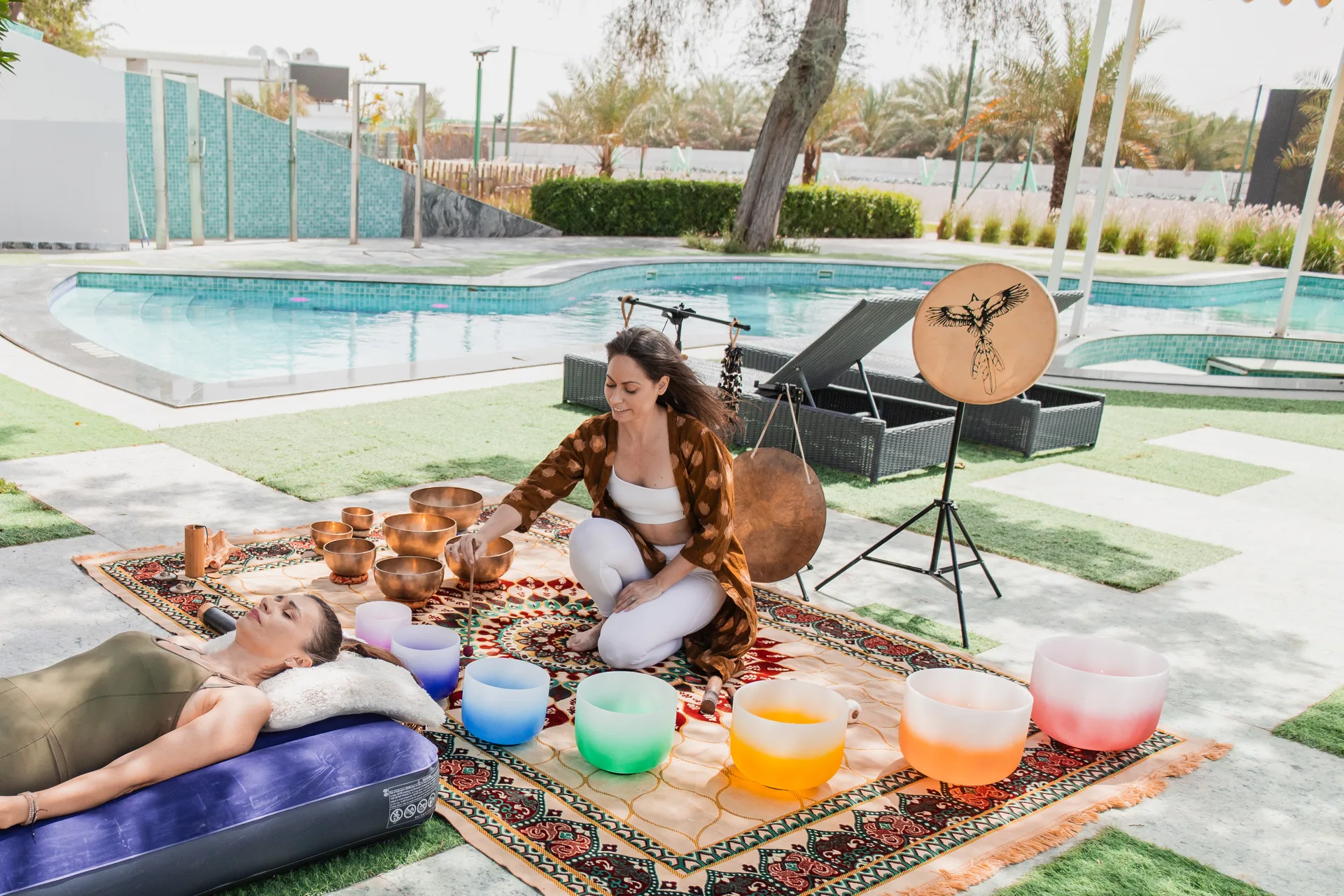
There is a moment in a sound healing session, usually around the 15-minute mark, when something shifts. The mental chatter that seemed impossible to quieten simply stops. The body, which has been holding tension since 6am, releases it without effort. The room, full of people, becomes very quiet in a very particular way.
According to Szilvia Timar, founder of The Mindful Paths and a certified sound healing practitioner with 17+ years of experience in corporate wellness: “The difference between thinking about relaxation and experiencing it is the difference between reading about swimming and actually getting in the water. Sound healing puts your nervous system in rest-and-digest mode before your conscious mind can argue about it. That is why it works for sceptics and stressed teams who have never meditated before.”
This is not mysticism. It is acoustics.
Sound healing, specifically the use of Tibetan singing bowls and gongs, is one of the oldest wellness practices in the world. It is also one of the most misunderstood. In the UAE’s corporate world, where evidence and results matter, the instinctive scepticism is reasonable. Which is why it is worth looking at what the science actually says.
The Science Behind Sound Healing
The foundation of sound healing is acoustic resonance. When a Tibetan singing bowl is struck or rimmed, it produces complex harmonic frequencies, typically between 100 and 700 Hz, that travel through the air and directly through the body. Unlike most sound we experience passively, the frequencies produced by high-quality metal bowls are engineered (deliberately or through centuries of refinement) to interact with the nervous system in specific ways.
The most significant mechanism is brainwave entrainment. Our brains naturally synchronise to external rhythmic stimuli, a phenomenon called the frequency following response. When exposed to slow, sustained tones in the theta frequency range (4-8 Hz) or the alpha range (8-12 Hz), brain activity measurably shifts toward those frequencies. The result is a meditative state that takes experienced meditators years to achieve voluntarily.
A landmark 2016 study published in the Journal of Evidence-Based Integrative Medicine followed 62 adults through a single Tibetan bowl meditation session. Participants reported significant reductions in tension, anxiety, and physical pain. Diastolic blood pressure and heart rate dropped measurably. Critically, those with no prior meditation experience showed the largest benefits, proving the practice requires no skill to receive.
A 2020 study in the Journal of Occupational Health examined the effects of sound therapy on workplace stress among corporate professionals. Participants who attended bi-weekly sound healing sessions over eight weeks reported a 42% reduction in self-reported stress and a 31% improvement in sleep quality compared to a control group. For Dubai teams managing high pressure, this outcome is measurable and replicable.
The physiological pathway is increasingly well-understood. Low-frequency sound vibration directly activates the vagus nerve, the primary nerve of the parasympathetic nervous system. Vagal activation triggers the rest-and-digest response: heart rate slows, cortisol production decreases, digestion normalises, inflammation markers drop. It is the antidote to the chronic fight-or-flight activation that defines modern professional life.
What Tibetan Singing Bowls Are and Where They Come From
Tibetan singing bowls, more accurately described as Himalayan singing bowls, as they originated across Nepal, Bhutan, and the Tibetan plateau, have been used in healing and ceremonial contexts for at least 2,500 years. Traditionally crafted from an alloy of seven metals corresponding to celestial bodies, high-quality antique bowls produce extraordinarily complex overtones that modern scientific instruments confirm as therapeutically distinctive.
Contemporary bowls range from machine-hammered decorative pieces to hand-hammered antique instruments that have been in use for generations. The quality of the bowl matters significantly in a therapeutic context. The overtone complexity of a well-made antique bowl, the way frequencies layer, interact, and decay, is not replicable by a factory-produced equivalent.
In a professional sound healing session, the practitioner typically uses multiple bowls of different sizes and tunings, placed around and sometimes directly on the body. Gongs, larger instruments capable of producing fuller frequency spectrums, are often used alongside bowls to create a more immersive soundscape. Szilvia, a certified Sound Healing Practitioner with 17+ years of experience, selects and plays instruments intentionally rather than randomly, which transforms the session from a pleasant listening experience into a genuine nervous system intervention.
What to Expect in Your First Session
A first-time participant typically arrives with a mixture of curiosity and mild scepticism. Both are welcome.
The session begins with brief guidance from the facilitator: how to position the body (typically lying down, though seated is equally valid), what might be experienced, and an invitation to simply receive rather than analyse.
Participants are given yoga mats, blankets, and eye pillows. The room is dimmed. Within minutes of the first bowl being struck, the audible environment changes in a way that is genuinely difficult to describe before experiencing it. The sound is not heard through the ears alone, it is felt in the chest, the back of the skull, the sternum. The vibration travels through the spine.
Most participants move through three recognisable phases. The first 10 to 15 minutes are a settling period. The mind continues its usual commentary. The body adjusts to the unusual sensory input. Some people feel mild restlessness as the nervous system begins to shift out of its habitual activation.
The second phase, typically minutes 15 to 45, is the deepest. The body has surrendered. Breathing has slowed. The mental commentary has reduced to intermittent fragments. Some people experience deep emotional releases, tears without distress, or a sense of grief or joy without a clear cause. These are physiological, not psychological, responses to vagal activation and should not be alarming. The facilitator understands this and holds space for whatever arises.
The final phase is a gradual re-emergence. The practitioner brings the session toward resolution with slower, lighter sounds. Participants return to ordinary awareness feeling, in most cases, as though several hours have passed in the best possible way. Many report that the effects linger for days.
Sound Healing for Corporate Groups
The corporate context adds a dimension that makes sound healing particularly valuable for teams: shared experience.
When a group of colleagues, from the CEO to the graduate intake, simultaneously experience deep relaxation for the first time, something shifts in the social architecture of the organisation. Shared vulnerability is the bedrock of genuine trust. A team that has navigated an ice bath, a sharing circle, or a sound healing session together has a foundation that no corporate offsite can manufacture through PowerPoint and group exercises.
The financial case is clear too. A team carrying chronic stress operates at 60-70% cognitive capacity. A two-hour sound healing session resets that baseline and returns the team to full capacity for weeks afterward. For a 20-person team at average Dubai salaries, a single AED 5,000 session represents approximately 40 hours of recovered productivity in the weeks following.
Practically, a corporate sound healing session requires minimal logistics. A quiet indoor space large enough for the group to lie down comfortably. No special equipment from the participant’s side, we bring everything. No preparation needed. Sessions work equally well in offices, hotel ballrooms, yacht decks, and outdoor pavilions.
Group size is flexible: 10 to 50 people for a standard session. For groups larger than 50, multiple sessions or a larger instrumentation setup is arranged. Sessions run 60 to 90 minutes and integrate naturally into a company half-day, wellness day, or annual event programme.
Who Benefits Most
Sound healing works for everyone, but the groups who tend to experience the most dramatic transformation are those carrying the highest chronic stress loads. In a Dubai corporate context, that description fits most senior leadership teams, client-facing roles, and high-pressure departments.
People who have “tried meditation and can’t do it” frequently find that sound healing achieves in 20 minutes what they have been unable to achieve in months of solo practice. The sound does the work. There is nothing to master.
People who are sceptical but open tend to have the strongest responses, perhaps because the letting-go that scepticism represents is itself a significant surrender.
People who struggle to access their bodies (a common result of years of intellectually demanding work) often find that the physical vibration in a sound bath is the first experience of genuine embodiment they have had in years.
If you are interested in bringing sound healing to your team or exploring it as a personal practice, the next step is simple. Book a free wellness plan and tell Szilvia about your situation, and she will reach out within 24 hours with a recommendation tailored to you. Get your free wellness plan and discover what a sound healing session might unlock for you or your team.
Szilvia Timar is the founder of The Mindful Paths and a certified sound healing practitioner with 17+ years of experience across holistic wellness modalities in Dubai and internationally.